I started in 2001, as an ambitious teen excited about a new hobby. I spent the 2013 season at the University of Minnesota Bee Lab. Dr. Marla Spivak encouraged me to partner with another beekeeper named Yuuki and start Four Seasons Apiaries, LLC. Marla believed regional breeding mattered, and so did we. We ran a queen rearing operation for five years, producing around 200 queens a season, selected for cold hardiness, mite resistance, and hygienic behavior.
Queen breeding is where recordkeeping stops being optional. When you're choosing which mothers to propagate, memory isn't a system.
I've been asking beekeepers about their note-taking systems ever since. Informally, obsessively. What works, what doesn't, why people stop.
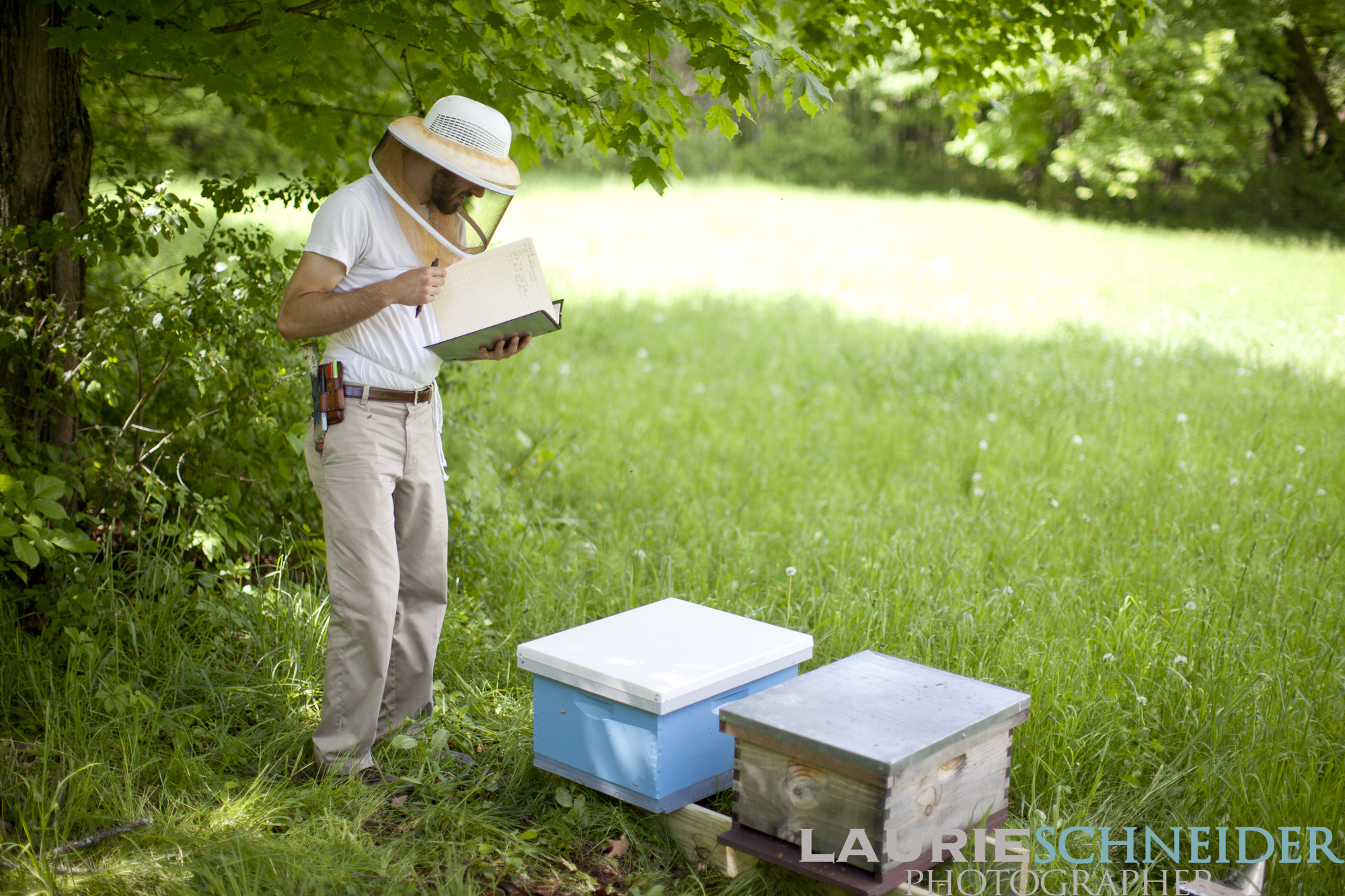
Binder system used at the start of Four Seasons Apiaries, 2014.
You can keep bees alive and healthy with open-ended notes and by turning a brick a certain way. Trying to log everything, every time, results in half a season of notes and then nothing.
The most useful hive records I've seen aren't the most detailed. They're elegantly simple and recorded consistently. Even queen breeders producing excellent bees only track a handful of metrics.
Inspection forms set a bar that beginners need - a checklist of what to look for. But for everyone else: miss one inspection and you feel the gap. Miss two and the system feels broken. Lower the bar, and the beekeeper who just says "cranky, heavy, saw the queen" every visit has a whole season of signal they can actually use.
I tried exhaustive records more than once. Every time, the same thing happened - the season got busy and the system collapsed under its own weight.
The gap between what you observed and what gets written down - that's where every system fails. The note you don't take because your hands are full of bees, because you're in a veil, because you'll remember it later.
It always was the problem. What's changed is the tools.
Voice-to-text models - not your phone's autocorrect, but AI models that actually understand beekeeping jargon - are good enough now to capture what you're seeing mid-inspection. And large language models can take what you said and turn it into something structured and searchable. The open-format note can finally be as useful as the checkbox form, without the weight that kills consistency.
This is the tool I wanted ten years ago when I was raising queens. It's possible now and we're building it.
I've kept bees my whole adult life and I still don't have them figured out. What I do have is a strong opinion about what helps: simpler notes, taken consistently, over a longer time. Better memory. Better records. Not so we can all agree on what good beekeeping looks like - so each of us can decide for ourselves, with actual evidence.
Joe Meyer
Founder of HiveScribe